
The midnight thread and the local-inference question#
What changes when Hy4 Flash moves from a hosted service to a quantized file on your own hardware? A developer put that question to Tencent’s Hy team on r/LocalLLaMA after seeing errors on a familiar work task. The answer pointed to the choice of quantization method and calibration. It also opened a more practical question for anyone sizing local hardware: which options belong to Flash, which are documented for flagship Hy4, and how much room do the files leave for inference? The Q&A started at midnight in Shanghai on 21 November, 8 a.m. Pacific time on 20 November, following the opening of flagship Hy4 weights earlier that day. Reddit Q&A
The developer said the hosted version completed the task without errors and a local NVFP4 build missed about 8% of the cases. The post identified a mixed-GPU setup and 96 GB of system memory but gave no public task set, repeat count or hosted backend precision. Tencent’s GeoMorax pointed the reader to the team’s GPTQ-calibrated NVFP4 build and said Tencent had measured a small gap against BF16 in its own evaluation. The two accounts describe separate evaluations. Their different baselines matter before either result informs a hardware purchase. Developer’s report and Tencent’s reply
The lead issue in the AMA is the reader’s benchmark question around quantized Flash. A local user reported that a Flash NVFP4 run failed on a task the user normally relies on. The team response pointed to quantization method and calibration as factors that can change outcomes. That is a narrower and more useful statement than a general verdict on Flash. It means the first question is not whether Flash is good or bad in the abstract. The first question is what exactly was compared: the same model revision, the same weight format, the same file, the same runtime and kernels, the same prompt length, and the same scoring rule. Without that matching, a failure can be a format problem, a calibration problem, a runtime problem, a task-sensitivity problem, or a combination. It cannot be promoted to a model-level conclusion on its own.
Reddit AMA thread on r/LocalLLaMA · Flash NVFP4 and calibration reply
Quantized Flash: match the test context before judging the result#
Quantization is not a single property that travels unchanged across files. It is a family of choices about numerical precision, weight representation, calibration data, scaling, kernels, and runtime integration. A model card can name a format, and a repository can publish a file, but the behavior of that file still depends on the inference stack that loads it and the workload that exercises it. General background is useful here: lower-precision formats trade numerical range or resolution for memory and speed, and calibration helps decide how to map real weight or activation ranges into the available representation. Different calibration data or different kernel implementations can therefore produce different outputs, especially on tasks that are sensitive to small numerical changes. The AMA reply is consistent with that general picture; it does not establish a universal ranking of formats.
The critical distinction is between a user’s local report and a team’s reference comparison. The user’s NVFP4 result belongs to one test context: one machine, one runtime, one file, one task, and one scoring method. A team BF16 comparison belongs to another context: a different precision, likely a different runtime path, and possibly a different evaluation setup. Those two contexts can both be honest and still not be directly comparable. One does not refute the other. A BF16 result can show what the model does under a reference precision without proving that a particular NVFP4 file will preserve that behavior on a user’s workload. A user’s failure can show that a specific local configuration is not acceptable for that workload without proving that all Flash builds fail. The correct reading is conditional: this file, this runtime, this task, this result.
Example 1 — a failed Flash NVFP4 task is not a Flash verdict. Suppose a developer runs a Flash NVFP4 file through a local runtime and finds that a structured extraction task loses field order or drops a required key. The developer also has a BF16 result from a different environment that preserves the fields. The useful next step is not to declare Flash unsuitable. It is to hold the model revision constant and vary one factor at a time: BF16 versus NVFP4 in the same runtime; two NVFP4 files with different calibration or packaging; the same file with a different kernel path; and the same file with a shorter prompt or smaller batch. If the failure follows the file across runtimes, the file or its calibration is the leading suspect. If the failure follows the runtime, the kernel or integration is the leading suspect. If the failure appears only at long context or high batch, the workload shape is part of the explanation. This is an illustrative workflow, not a reported test result.
A benchmark question should therefore be written as a comparison contract. It should name the exact model identifier and revision, the weight format, the file or repository revision, the runtime and kernel build, the quantization recipe if published, the prompt or evaluation set, the context length, the batch size, the sampling settings, and the scoring method. It should also record whether the comparison is online or local, because an online endpoint and a local file are different serving contexts even when the model family is the same. If any of those fields is missing, the result is still evidence, but it is weaker evidence. It can justify a local caution. It cannot justify a broad claim about the model family.
Tencent’s model card lists 12 billion active parameters per token for Hy4 Flash and a 64-billion-parameter Engram component. The active count describes the computation path for a token. Capacity planning also has to account for stored weights, runtime buffers, batch size, context length and the selected quantization. The distinction matters even when two builds share an active-parameter count and expose the same chat interface. They can occupy different amounts of memory, send different work to the GPU and behave differently at the task a team actually needs to run.
Hy4-flash model card · Flash GGUF repository
Flash builds and flagship support are separate tracks#
The AMA becomes easier to read once Flash and flagship Hy4 are kept on separate tracks. Flash is the smaller, faster branch where quantized builds and community-facing file formats are central to local experimentation. Flagship Hy4 is a much larger model with its own published deployment story. The Hy4 model card lists a 770B language backbone and 49B activated parameters per token. It also documents official FP8 support and links compressed GGUF artifacts. Those are concrete, checkable facts about the flagship’s published support surface. They are not evidence that every quantization format is enabled, and they are not evidence that a particular local machine can hold the model.
The team’s reply about flagship formats draws a line that matters for anyone assembling a local stack. The reply indicates that formats such as NVFP4 are not enabled for the flagship, and the community link cited in that context is a Flash example. That distinction is easy to blur because the model family name is shared and because both branches appear in the same AMA thread. A Flash NVFP4 file and a flagship NVFP4 file are not interchangeable deployment decisions. A Flash quantized build may be an active part of the local ecosystem. A flagship NVFP4 build is not established by that discussion. The flagship’s documented FP8 path and linked compressed GGUF artifacts are the relevant starting points; an unsupported format claim should not be inferred from Flash activity.
Example 2 — a flagship NVFP4 file and a Flash NVFP4 file are different decisions. Imagine an operator with a fixed GPU budget who sees a community post about NVFP4 and assumes the same route applies to Hy4. The operator should first ask which model branch the post concerns. If the post concerns Flash, it says something about a smaller branch and its quantized ecosystem. It does not establish that the flagship has an enabled NVFP4 path. For the flagship, the operator should start from the documented FP8 support and the linked compressed GGUF artifacts, then verify the exact file and runtime combination. If the operator needs NVFP4 specifically, the correct conclusion from the AMA is that flagship NVFP4 is not confirmed in that reply, not that a flagship NVFP4 file has been validated elsewhere. This is a decision-tree example, not a performance claim.
Memory planning is similarly branch-specific. The fact that a model can be described as 49B active per token does not mean it needs only the memory associated with 49B parameters. Active parameters describe the computation path; resident weight memory depends on the total stored weights and the format. On top of weights, a local deployment needs room for runtime buffers, attention or KV cache, batching, and context. The same model at a longer context can need substantially more memory than a short-prompt demo. This is why a model’s parameter label, a quantized file size, and a machine’s RAM are three different numbers. A deployment decision needs all three, plus a measured run.
Hy4 model card · Flagship format reply
The 64–128 GB question: roadmap language, not a memory specification#
The 64–128 GB discussion is the part of the AMA most likely to be overread. Two different replies point toward smaller models still being planned. One reply mentions a Hy4-mini on the roadmap. Another addresses a question about the 64–128 GB RAM range. Those are related signals, but they are not a product announcement. The range is a community question about a memory envelope; it is not a published supported configuration. The roadmap mention is a statement of intent or direction; it is not a launch date, a file listing, or a validated deployment target. The distinction is not pedantic. Local operators budget hardware against supported configurations, and a roadmap conversation can easily become an accidental procurement spec if it is repeated without its status label.
No launch commitment appears in the material used here. That absence is itself a finding. It means a reader should not infer a release window, a model size, a quantization plan, or a minimum memory requirement from the 64–128 GB exchange. The team also discussed post-training and larger-model work in the same AMA. Those topics show that optimizing existing models, shrinking deployment scale, and building larger models are different workstreams. A smaller-model roadmap item does not imply that the flagship is being replaced. A post-training discussion does not imply a new checkpoint. A memory-range question does not imply that a model has been fitted to that range. Each statement needs to be kept in its own lane.
Example 3 — turn a 64–128 GB question into a test plan, not a support claim. Suppose a team has a 96 GB machine and wants to know whether the AMA gives them a green light. It does not. The useful response is to define a test matrix: which model branch, which documented format, which exact file, which runtime, which context lengths, and which batch sizes. The team should measure peak resident memory and output quality for each combination rather than treating the midpoint of a community range as a target. If a Flash build fits at a short context but fails at the team’s required context length, the machine is not validated for that workload. If a flagship compressed artifact fits only with a particular runtime and a small batch, that is a measured configuration, not a general 64–128 GB endorsement. The range can help frame a question. It cannot answer the fit question by itself.
The same caution applies to the phrase smaller model. A smaller model can mean fewer total parameters, a different active-parameter path, a different quantization scheme, or a different deployment target. The AMA material does not resolve those possibilities into a specification. A reader can reasonably conclude that Tencent Hy is discussing continued work on smaller models. A reader cannot reasonably conclude that a named model with a known size, memory floor, and release date exists. The roadmap status should be recorded as roadmap status until a model card, repository, or release note supplies the missing details.
Smaller-model roadmap reply · 64–128 GB question reply
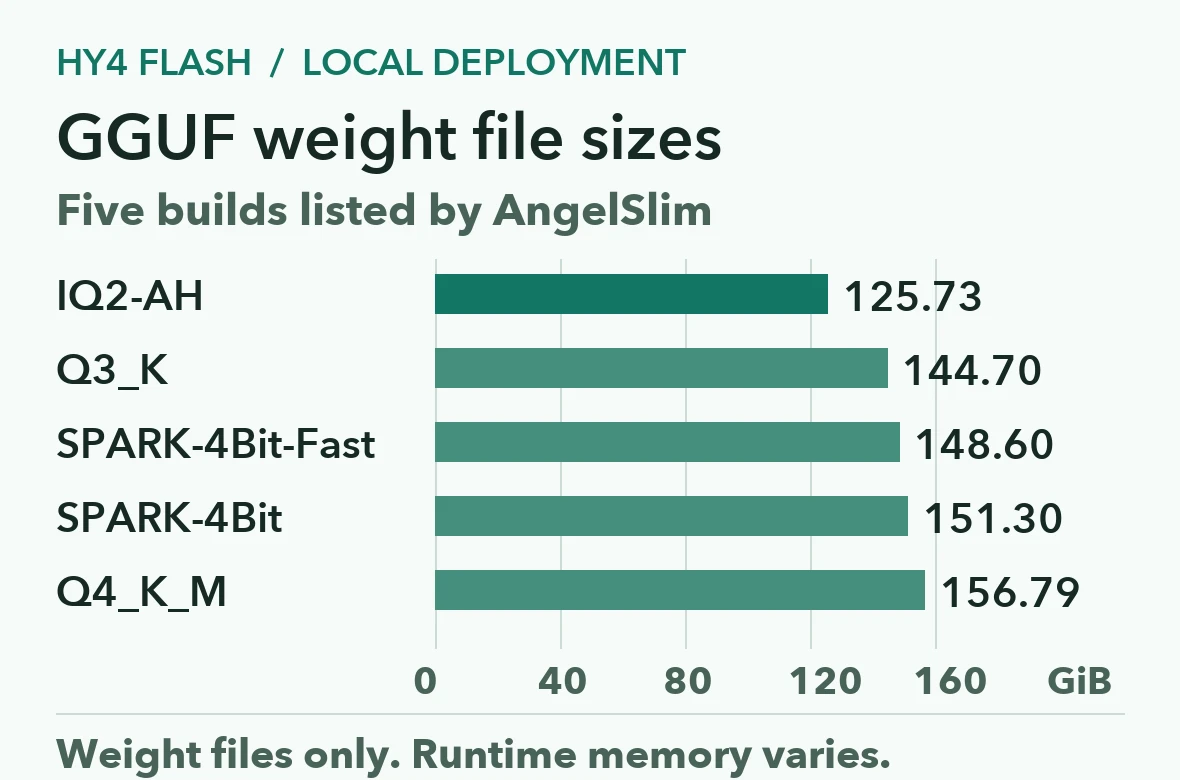
Five Flash downloads show where the memory budget starts#
The Flash GGUF repository lists five sets of weights at different sizes. AngelSlim’s smallest entry, IQ2-AH, is 125.73 GiB. Q3_K is 144.70 GiB, SPARK-4Bit-Fast is 148.60 GiB, SPARK-4Bit is 151.30 GiB and Q4_K_M is 156.79 GiB. The two ends of the range differ by 31.06 GiB. That is a material difference for storage, distribution and the margin left for everything else on a machine. The files belong to the Flash branch and the figures in the chart are the repository’s reported weight sizes. AngelSlim’s Flash GGUF model card
The units matter at the low end. The 125.73 GiB file occupies about 135 GB when measured in decimal gigabytes, so a machine advertised with exactly 128 GB of addressable memory and no other memory pool would already be below the weight-only total if all weights had to be resident together. Even a machine with 128 GiB would have only about 2.27 GiB left after the file amount, before the process, operating system, attention cache and work buffers. These are arithmetic comparisons, not measurements of memory use. Device offload and memory-mapped storage can change where the bytes live and how quickly they are read. That is why an apparently small difference between GB and GiB can change the interpretation of a threshold without settling the performance question.
The repository separately lists a visual projection file. A team evaluating image inputs has another artifact to account for as well as the runtime’s method for preparing media. The storage comparison also leaves out time to load the model, tokens per second and quality of output. Those questions become more significant when the chosen workload alternates text and images or keeps long sessions open. A shorter download is an immediate operational advantage for distribution. Whether its numerical precision is sufficient depends on the application and the runtime. Flash files and model documentation
AMA context and timing record · Post-training discussion reply
Source limitations and what would change the conclusion#
The source set has clear limits. It contains a public AMA thread, individual replies, model cards, and a GGUF repository. It does not contain an independent reproduction of the Flash NVFP4 report. It does not contain a controlled benchmark from a neutral party. It does not contain a published supported-configuration table for the 64–128 GB range. It does not contain a release note for a smaller model. Those absences matter because the article’s conclusions are correspondingly bounded. The AMA supports a clarification of deployment categories. It does not support a performance ranking, a memory guarantee, or a launch forecast.
Tencent’s model card gives Flash a context window of up to one million tokens. A maximum context length describes an advertised model capability. It gives operators a reason to test their deployment at the prompt sizes they need, since memory and latency can change sharply as prompts grow. Short conversations, a long text corpus and a queue of simultaneous requests are distinct workloads even on the same checkpoint. For locally hosted tooling, documenting the longest working context at the target concurrency is more practical than recording the architectural ceiling alone. Hy4 Flash model card
The most important limitation is the separation of test contexts. One user’s result and one team report are not two votes in a poll. They are different experiments with different controls. The user’s NVFP4 run may be highly relevant to that user’s stack, and the team’s BF16 comparison may be highly relevant to a reference deployment, but neither automatically overrides the other. A stronger conclusion would require a matched comparison: same model revision, same evaluation set, same runtime family, and only the weight format varied. Without that, the honest claim is that quantization method and calibration can affect results, and that local validation remains necessary.
What would change the conclusion? A published model card that names supported quantization formats for the flagship would sharpen the support boundary. A controlled benchmark that varies only the weight format would clarify the Flash NVFP4 question. A repository or release note with a named smaller model, a memory floor, and a launch date would move the roadmap discussion into a confirmed configuration. A measured memory profile at defined context lengths would replace the 64–128 GB speculation with a testable fit statement. Until then, the article’s practical advice remains conditional rather than predictive.
Hy4-flash model card · Hy4 model card · Flash GGUF repository
Practical decision guide for local operators#
For a local operator, the AMA’s most useful output is a decision sequence. First, identify the branch: Flash or flagship. Second, identify the documented format for that branch. Third, identify the exact artifact and revision. Fourth, define the workload: prompt length, context length, batch size, and scoring. Fifth, measure the full stack rather than inferring memory from a parameter label. Sixth, record whether the result came from a user context, a team context, or a matched comparison. That sequence is slower than reading a headline number, but it prevents the most common error in local deployment: treating a family name as if it were a validated configuration.
Example 4 — a procurement note that survives review. A team wants to buy a machine for local inference and drafts a note saying the AMA discussed 64–128 GB, so a 96 GB box should be sufficient. A reviewer should reject that inference. A better note would say the AMA discussed a 64–128 GB community question and mentioned smaller models on the roadmap, but published no supported configuration. The team will therefore benchmark Flash and flagship artifacts that are documented for their branch, at their required context length, and will record peak memory and quality. The purchase decision will follow the measured result, not the midpoint of the range. This example shows how to use the AMA as evidence without turning a question into a requirement.
For Flash users, the calibration reply argues for keeping a reference run and a quantized run side by side. A reference BF16 or official-format result can help distinguish a model behavior from a quantization artifact, but only if the rest of the context is close enough. For flagship users, the format reply argues for starting with the documented FP8 path or linked compressed artifacts and treating NVFP4 as unconfirmed until a branch-specific source says otherwise. For teams watching the roadmap, the smaller-model discussion is a signal to monitor model cards and repositories, not a reason to freeze a hardware plan around an unnamed future model.
The broader lesson is that local inference decisions are evidence problems. A model family can have an active community, a rich set of quantized files, and a detailed AMA, and still require a local test before a deployment claim. The Tencent Hy AMA is valuable because it makes several of those boundaries explicit: Flash quantization needs matched comparison, flagship formats are not interchangeable with Flash formats, and the 64–128 GB range is a question rather than a specification. Those are modest conclusions, but they are durable. They tell a reader what to verify next, which is more useful than a premature verdict.